
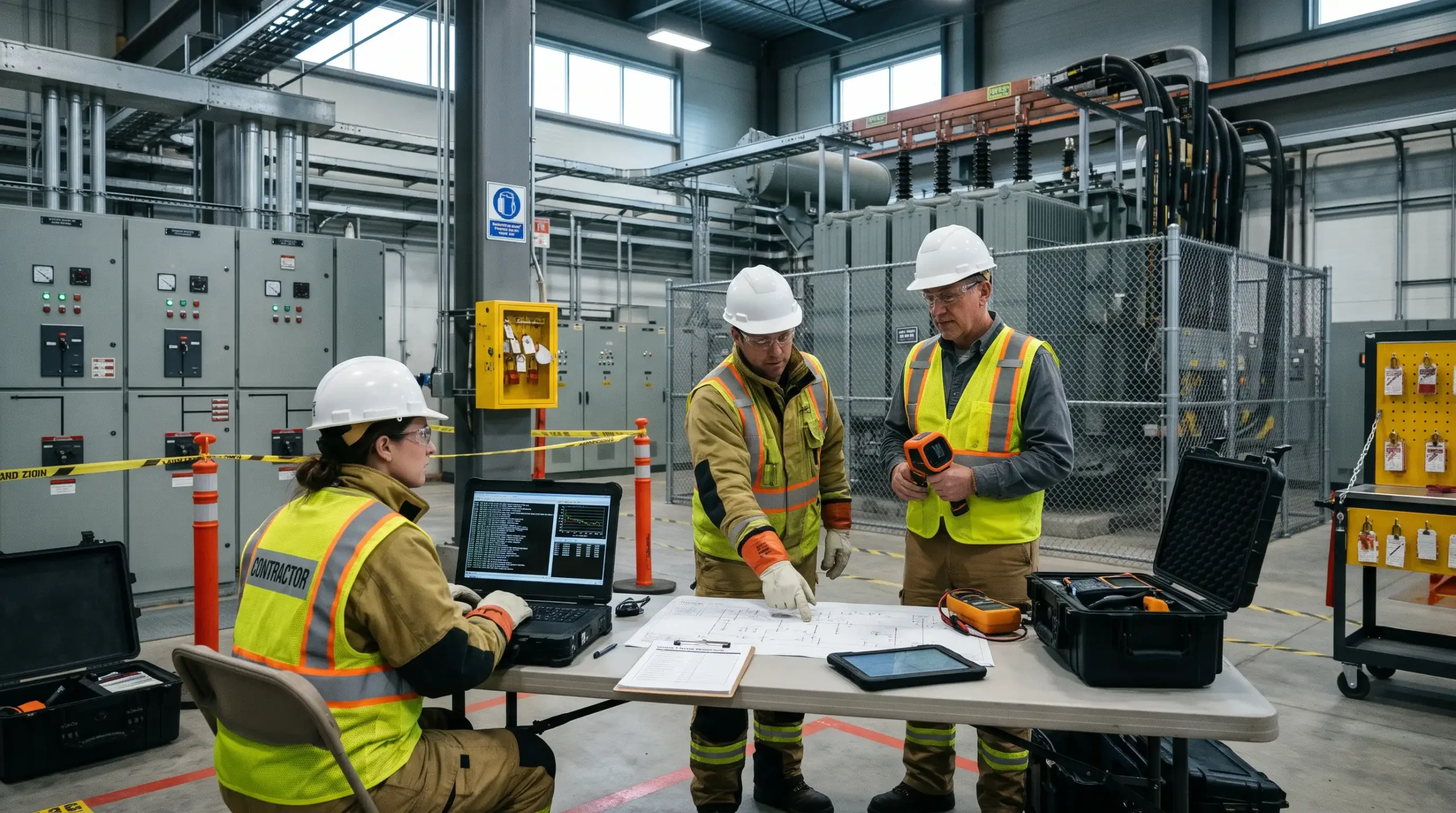
Electrical failures rarely occur at a convenient time.
A power transformer may trip during peak production, an unexpected fault may develop on a medium-voltage cable, or a main circuit breaker failure may interrupt an entire production line.
If the response strategy is discussed for the first time after the fault occurs, valuable time is already being lost.
For this reason, factories, power generation facilities, solar power plants and wind farms should prepare an emergency electrical fault response plan before an actual emergency occurs.
The objective is not simply to restore power as quickly as possible. The faulty section must be safely isolated, correctly diagnosed and repaired before the electrical system is returned to service under controlled conditions.
An emergency electrical fault response plan is a technical and operational procedure that defines the actions to be taken when a critical electrical failure occurs.
The plan should identify:
A well-prepared plan reduces uncertainty during an emergency.
Not every electrical asset has the same impact on production.
A main power transformer failure and a minor fault in an auxiliary distribution panel do not normally have the same consequences.
Critical equipment should therefore be identified in advance.
Depending on the facility, the list may include:
The operational impact of each possible failure should also be evaluated.
One of the most valuable documents during an electrical emergency is an accurate single-line diagram.
Which transformer supplies which switchboard? Which MV cable is connected to which switchgear panel? Is an alternative supply available? Which loads can be supported by the emergency generator?
These questions should not have to be investigated from scratch during an emergency.
Every significant modification to the electrical system should be reflected in the documentation.
If new machinery, transformers, panels or switchgear have been installed without updating the drawings, the risk of incorrect switching decisions increases.
Speed is important during emergency response, but it must never take priority over electrical safety.
The suspected faulty section should be de-energized using the appropriate operating procedures and secured against unintended re-energization.
The absence of voltage should be verified before work begins.
Repeatedly closing a circuit breaker without understanding the cause of the trip, or bypassing protection functions to restore production, is not an appropriate troubleshooting strategy.
Work on MV and high-voltage systems should be carried out by qualified personnel.
A circuit breaker trip does not automatically mean that the breaker itself is defective.
In many cases, the circuit breaker has simply executed a trip command issued by the protection system.
One of the first questions should therefore be:
Which protection function operated?
Depending on the relay and system configuration, engineers may review:
This information can provide valuable clues about the location and nature of the electrical fault.
In facilities equipped with SCADA, the event sequence before a fault can provide valuable diagnostic information.
For example, a transformer temperature alarm may have occurred first, followed by a cooling fan alarm and finally a protective trip.
In another case, communication with an MV switchgear panel may have failed shortly before the breaker opened.
SCADA alarms should therefore be reviewed chronologically.
Jaka Energy SCADA Automation services can also support the development of monitoring and control infrastructure for industrial and power facilities.
If a transformer has tripped through its protection system, it should not be immediately re-energized without investigating the cause.
Initial checks may include:
If required, additional electrical tests such as insulation measurements, winding resistance, transformer ratio testing or oil analysis may be planned.
The objective is not merely to make the transformer accept voltage again. The objective is to determine whether re-energization can be performed safely.
The first step in an MV cable fault is to confirm which cable circuit is affected.
Protection records, cable route information and field observations should be evaluated together.
Appropriate fault-location methods can then be used to narrow down the defective section.
For underground cables, accurately locating the fault can significantly reduce repair time compared with excavating a large section of the route.
After repair, appropriate electrical tests should confirm that the circuit is ready to return to service.
Jaka Energy MV cable installation and testing services can cover cable installation, termination, jointing and testing activities.
When a fault occurs inside MV switchgear, the scope of the problem should be determined before physical intervention.
If a circuit breaker does not open or close, engineers may inspect:
A breaker should not be considered ready for service merely because it can mechanically open and close.
The original fault condition that caused the protective operation must also be confirmed as cleared.
In some power facilities, the main electrical system may be healthy while control and protection equipment becomes unavailable because of a DC auxiliary supply problem.
Protection relays, circuit breaker trip circuits and control systems often depend on batteries and battery chargers.
An emergency response plan should therefore include checks of:
A single DC supply failure may affect several pieces of equipment simultaneously.
Having an emergency generator installed does not automatically mean emergency power is available.
The following systems must also be ready:
The loads to be supplied by the generator should be identified in advance.
It should never be assumed that all facility loads can be transferred to the generator simultaneously.
Some facilities can isolate a defective section and continue operating part of the plant through an alternative power source.
However, the strategy should be designed before the emergency occurs.
Possible alternatives may include:
The capacity of the alternative supply must also be assessed.
Transferring all loads from a failed transformer to another transformer may overload the remaining unit.
For some electrical failures, the longest part of the outage is not the repair itself but waiting for the required replacement component.
A spare-part strategy should therefore be developed for critical equipment.
Depending on the facility, the list may include:
It is not economical to keep every component in stock. Criticality and procurement lead time should be evaluated together.
In major industrial facilities, it may be reasonable to maintain complete spare equipment in addition to smaller spare parts.
Examples may include:
The decision should consider the cost of the equipment together with the potential cost of production downtime.
Time should not be lost trying to determine who to contact after a critical fault occurs.
The emergency plan may identify:
Contact information should be reviewed periodically.
An emergency document containing outdated telephone numbers is not an effective response tool.
Some important evidence may disappear shortly after an electrical incident.
The following information should therefore be recorded as soon as possible:
Protection relay and SCADA records should be preserved before being cleared whenever possible.
This information is valuable during root-cause analysis.
Under suitable and safe operating conditions, thermal imaging may help identify certain electrical problems.
Possible findings include:
However, thermal imaging should not be treated as a complete fault diagnosis by itself.
The findings should be evaluated together with electrical measurements and physical inspections.
The availability of electrical test equipment should be planned before an emergency.
Depending on the facility, engineers may need:
Availability alone is not enough. The correct instrument must be used by competent personnel.
In solar power plants, faults involving inverters, transformers, MV switchgear and DC cable systems can directly reduce energy production.
The emergency plan should define which inverter or production section can be safely isolated.
Where the plant design allows, maintenance may be carried out on one section while the remaining sections continue generating.
SCADA production data can also help identify the affected part of the plant.
Wind turbines are distributed across large areas, making field coordination especially important during an emergency.
When a turbine transformer, MV cable or collector system fault occurs, operators should quickly identify which turbines are affected.
If the fault is limited to a single turbine or feeder section, the objective may be to keep the rest of the wind farm operating.
MV network architecture and switching scenarios should therefore be included in the emergency response documentation.
A device disappearing from the SCADA screen does not necessarily mean that the equipment has lost electrical power.
A communication failure must be distinguished from a power-system failure.
Troubleshooting may include:
Field equipment should not be assumed to be de-energized based solely on the SCADA display.
A fault appearing to be repaired does not automatically mean that immediate re-energization is appropriate.
Before energization, engineers should verify:
A suitable commissioning procedure should then be followed.
Jaka Energy Testing and Commissioning services can support the controlled return to service of electrical systems following maintenance and repair activities.
The first operating period after repair is particularly important.
Current, voltage, temperature and alarm information should be monitored.
Repaired connections may be inspected again under appropriate operating conditions.
If the same protective alarm occurs again, repeatedly restoring the system without deeper investigation should be avoided.
Emergency response should not be considered complete simply because production has restarted.
The following question must be answered:
Why did the failure occur?
If an MV cable termination fails, installing a new termination may not be enough.
Installation quality, moisture, mechanical stress, operating temperature and grounding should also be evaluated.
Preventing the same failure from happening again requires elimination of the underlying cause, not just replacement of the damaged component.
Every major electrical failure provides useful information about the condition of the facility.
If a circuit breaker that has not been included in the maintenance program for several years develops a serious problem, similar breakers may also require inspection.
Likewise, mechanical damage identified on one cable route may justify checking other sections exposed to similar conditions.
Emergency fault records should therefore be used when updating preventive maintenance programs.
Yes.
Critical facilities can review their response plans through tabletop exercises or controlled field scenarios.
Examples include:
“What happens if Transformer 1 becomes unavailable?”
or
“What switching actions are required if the main MV cable feeder fails?”
Reviewing these scenarios in advance can significantly reduce decision-making time during a real incident.
A practical emergency electrical response file may contain:
Maintaining both digital and appropriately accessible backup copies can also be considered.
Not every electrical fault can be completely prevented.
However, preventive maintenance can identify many developing problems before they become critical failures.
Thermal inspections, insulation measurements, transformer maintenance, protection relay testing and cable inspections can reveal deterioration at an earlier stage.
For this reason, one of the most effective emergency response strategies is a preventive maintenance program designed to reduce the number of emergencies in the first place.
The first priority is the safety of personnel and the facility. The affected section should be isolated using appropriate procedures, and the electrical condition must be verified before work begins.
The breaker should not be repeatedly reclosed without determining why it tripped. Protection records and the associated electrical system should first be evaluated.
The cause of the trip and the transformer condition should be evaluated first. Required inspections and tests should be completed before deciding to re-energize the transformer.
Not necessarily. The fault location and extent of damage should first be determined, after which an appropriate repair strategy can be selected.
Such plans are especially important for factories, power generation facilities, solar plants, wind farms and other facilities where electrical outages can significantly affect production, safety or critical operations.
Correct diagnosis and controlled intervention during transformer, switchgear, MV cable, distribution panel, generator and SCADA failures can significantly reduce unplanned downtime. To develop a suitable scope for electrical maintenance, fault diagnosis, testing, installation and commissioning at your facility, contact Jaka Energy.


