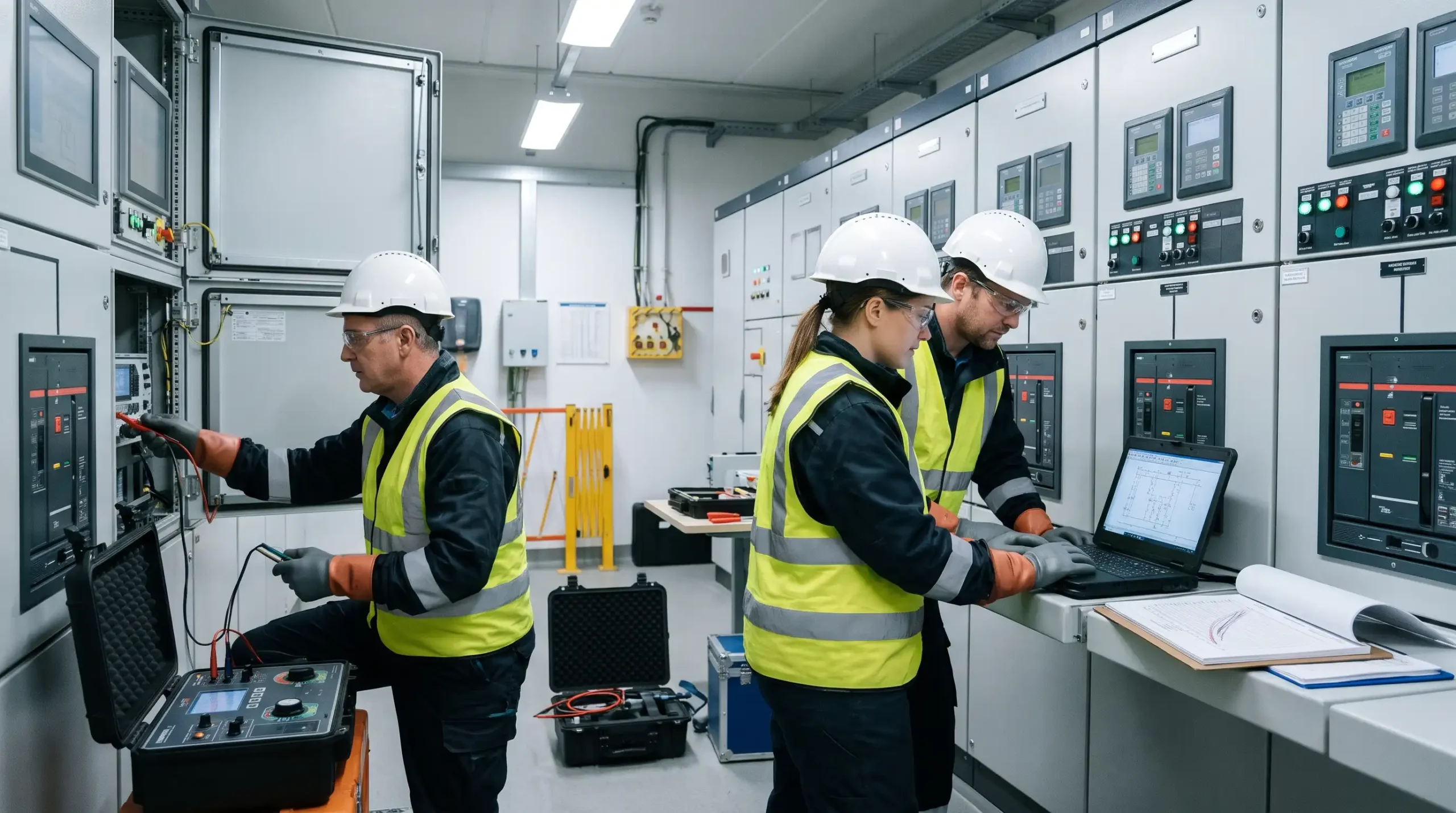
The purpose of an electrical protection system is not only to detect faults. It should also isolate the smallest practical section of the electrical network while allowing healthy sections to continue operating.
This is where protection relay coordination and selectivity become important.
For example, a fault on a single production feeder should not unnecessarily trip the main incoming circuit breaker and shut down the entire factory.
For additional information about protection relay testing, see Jaka Energy’s article on Protection Relay Testing.
Relay coordination evaluates protection relays and circuit breakers throughout an electrical network so that they operate in the correct sequence.
The study may consider:
The objective is to ensure that the correct protection device operates at the correct time.
Selectivity means that the protection device closest to the fault should normally operate before upstream devices.
If a fault occurs on a downstream feeder, the feeder protection should isolate that section while the main electrical system remains energized whenever the network design allows.
This is particularly important in large factories, power facilities and multi-transformer electrical systems.
Incorrect relay settings may result in nuisance trips or delayed fault clearing.
Possible consequences include:
Protection settings should therefore be based on the electrical system rather than entered independently into each relay.
Depending on the facility, coordination can include:
Jaka Energy Testing and Commissioning services can support protection relay, circuit breaker, transformer and electrical equipment testing.
Yes.
The protection system may need to be reviewed after adding:
Settings developed for the original facility should not automatically be assumed to remain suitable after major electrical modifications.
Calculating the correct relay setting is only the first step.
Secondary injection testing can verify that the relay operates according to the programmed current and time settings.
The trip command from the relay to the circuit breaker can also be verified.
This allows the complete protection chain to be evaluated rather than checking the relay alone.
Modern protection relays can transmit trip, alarm and equipment status information to a SCADA system.
This helps operators identify which protection function operated during an electrical event.
Jaka Energy SCADA Automation solutions can support centralized monitoring of protection relays, switchgear and other electrical equipment.
Even correctly coordinated systems can change over time.
Changes such as new CT ratios, cables, loads or protection relays may affect the original coordination.
For this reason, major changes identified during electrical installation inspections should also be considered from a protection-system perspective.
It helps isolate the electrical section closest to the fault while reducing unnecessary outages in healthy parts of the network.
An upstream main breaker may trip for a downstream fault, causing a much larger section of the facility to lose power.
Yes. Changes in transformer rating and electrical characteristics may require the protection settings to be reassessed.
No. Coordination is important in both medium-voltage and low-voltage distribution networks.
Coordinated operation of protection relays, circuit breakers, transformers and cable systems can reduce unnecessary outages and improve electrical system reliability. For relay coordination, protection testing and electrical system assessment, contact Jaka Energy.