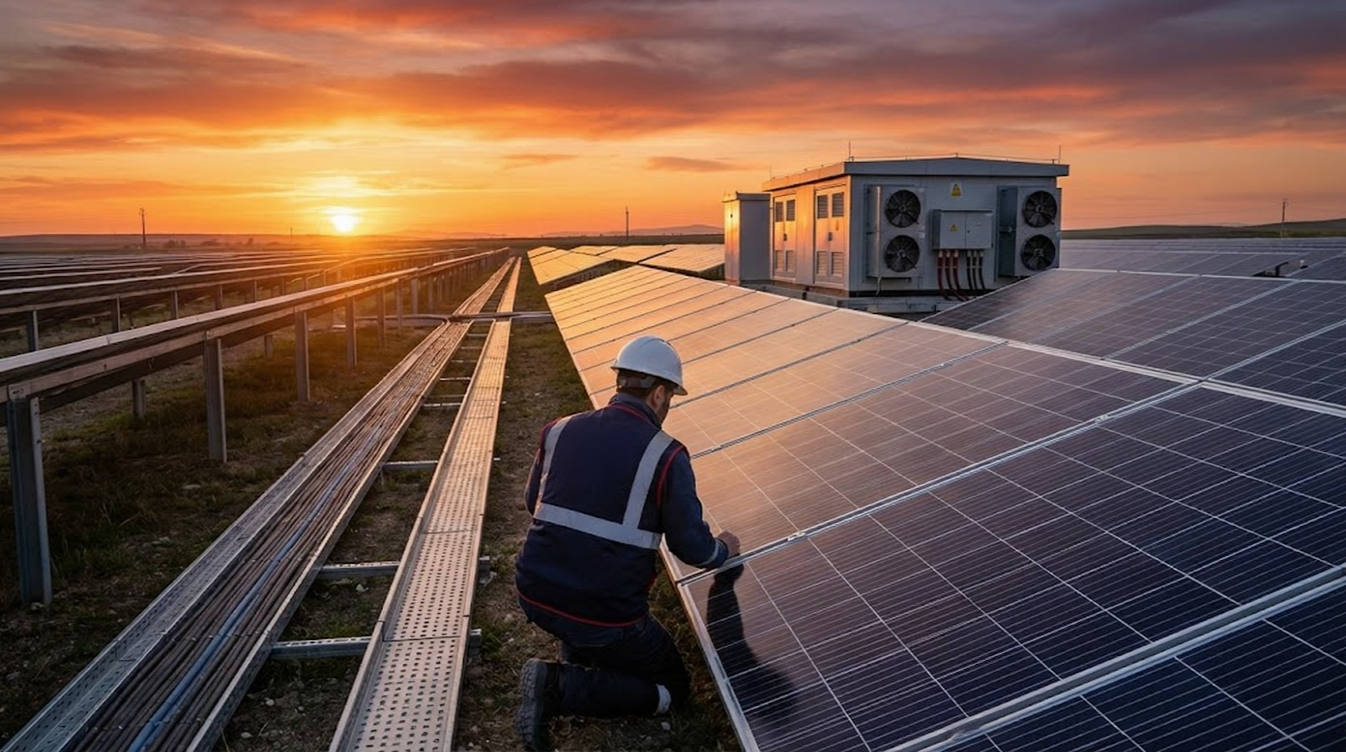
Solar Power Plants (PV Systems) are modern, sustainable facilities that convert sunlight directly into electrical energy. As electricity costs rise worldwide, solar investments have become one of the most profitable and predictable energy solutions for industrial facilities and investors.
This article explains how PV systems work, the engineering behind them, installation phases, maintenance requirements, and financial advantages.
☀️ How Does a Solar Power Plant Work? Main Components
- PV Modules
Convert sunlight into direct current (DC).
- Inverters
Convert DC into grid-compatible alternating current (AC).
- Protection & Compensation Systems
Ensure safe and stable transmission of energy.
- Transformer & Medium Voltage (MV) Equipment
Step up voltage for grid connection.
- SCADA & Monitoring Systems
Track performance, detect failures, and optimize efficiency.
A well-designed system can operate efficiently for up to 25–30 years.
⚡ Solar Plant Installation – Step-by-Step
1. Site Analysis & Solar Assessment
- Solar radiation & shading analysis
- Roof or land suitability
- Energy production estimates
2. Engineering & Design
- Electrical & mechanical project design
- Cable sizing
- Protection equipment selection
- MV infrastructure design
At this stage, Jaka Enerji’s experience in MV cable assembly, testing, and commissioning provides a significant advantage.
3. Official Applications & Approvals
- Utility company applications
- Connection agreements
- TEDAŞ/TEİAŞ approvals
4. Mechanical & Electrical Installation
- Mounting structures
- PV module installation
- Inverter & AC/DC panel setup
- MV cable connections and transformer installation
5. Testing & Commissioning
Critical for long-term reliability:
- Insulation measurements
- Grounding tests
- MV cable tests
- Transformer testing
- SCADA communication checks
6. SCADA Integration
Allows real-time monitoring, performance optimization, and fault detection.
✔️ Advantages of Solar Power Systems
1. Low Operating Costs
Minimal maintenance required.
2. Predictable Energy Costs
PV systems protect businesses from rising electricity prices.
3. Long System Lifetime
25+ years of stable electricity production.
4. ESG & Carbon Reduction Benefits
Helps companies meet sustainability goals.
5. Strong ROI
In Turkey, ROI typically ranges from 3.5 to 6 years.
🛠️ Maintenance & Periodic Tests for PV Plants
- PV cleaning
- Grounding resistance tests
- DC insulation tests
- Infrared thermal inspection
- Transformer & MV equipment tests
- SCADA performance analysis
- Partial discharge (PD) tests
🔍 Common Mistakes That Reduce PV Efficiency
- Incorrect panel angle
- Wrong inverter sizing
- Poor-quality cabling
- MV termination failures
- High grounding resistance
- Lack of SCADA integration
These mistakes can reduce production by 5% to 40%.
🎯 Conclusion
Solar power plants are no longer “future technology” they are today’s most profitable and sustainable energy investment. With proper engineering, MV installation, cable testing, and professional commissioning, your system can operate safely for decades.
👉 If you are planning to invest in solar energy, partner with Jaka Energy’s expert engineering and commissioning services for a safe, efficient, and long-lasting PV system. Contact us today and unlock the full potential of your solar project! https://jakaenerji.com/en/contact/