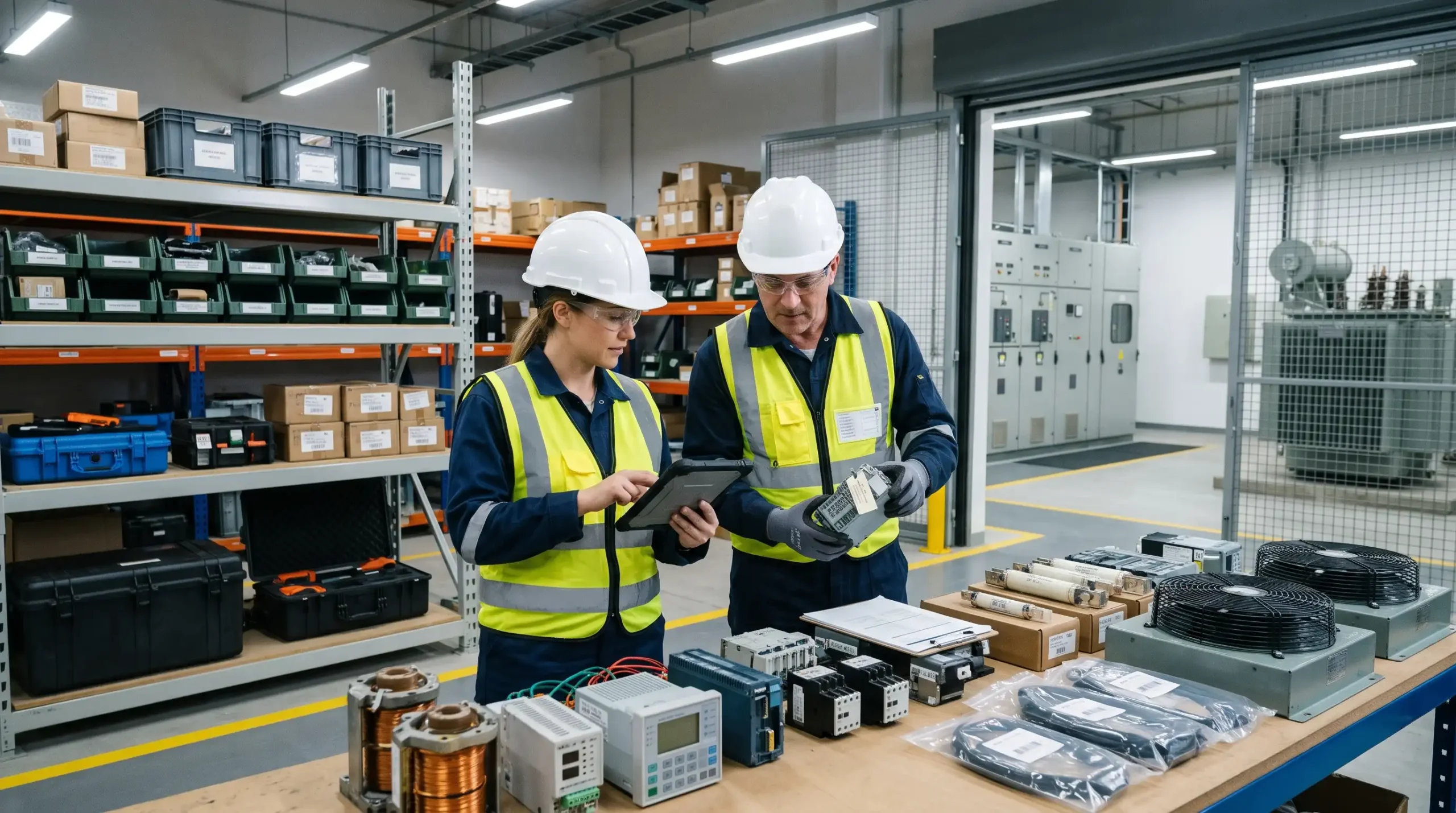
An electrical failure may require only a few hours of technical repair work. However, if the required replacement component is unavailable, the facility may remain out of service for days.
Electrical maintenance planning should therefore answer not only “What can fail?” but also “How quickly can we obtain the part when it fails?”
Transformers, medium-voltage switchgear, circuit breakers, protection systems, generators, cable systems and SCADA infrastructure can contain components with long procurement lead times.
Some equipment may even be obsolete and no longer supported by the original manufacturer.
Critical spare-parts planning is designed to manage these risks before an actual failure occurs.
A critical spare part is a component whose failure can significantly affect production or electrical distribution and which may not be quickly available when required.
Cost alone does not determine criticality.
For example, a relatively inexpensive circuit breaker trip coil may become highly critical if its failure prevents an essential MV breaker from operating.
Similarly, a small industrial communication module can affect the monitoring of a large section of the facility.
Criticality should therefore be evaluated according to operational impact, not physical size or purchase price.
Before developing a spare-parts strategy, the facility should have an accurate electrical equipment inventory.
The inventory may include:
Facilities expanded over many years often contain equipment from different manufacturers and generations.
Without an accurate asset inventory, effective spare-parts planning becomes difficult.
Keeping spare components for every electrical asset is rarely economical.
Equipment can therefore be classified according to criticality.
These are assets whose failure could stop the entire facility or a major production section.
Examples may include:
These assets may affect only part of production or may have an alternative supply arrangement.
Equipment with limited production impact and readily available replacement components may be placed in this category.
This approach helps direct the spare-parts budget toward the most important risks.
Criticality assessment should always include procurement lead time.
A standard fuse available locally should not be managed in the same way as a manufacturer-specific breaker mechanism requiring a long production cycle.
Longer lead times may apply to:
Actual delivery times should be reviewed with suppliers before establishing inventory levels.
Power transformers have long service lives, but many auxiliary components can fail during operation.
Depending on the transformer design, possible critical spares include:
The required list depends on the transformer type and facility configuration.
Recurring findings identified during transformer maintenance can also be used to improve the spare-parts strategy.
Jaka Energy Testing and Commissioning can support the electrical assessment of transformers and related equipment.
Medium-voltage circuit breakers are essential components of electrical distribution systems.
Even when the main breaker assembly is healthy, the failure of a relatively small auxiliary component can make the breaker unavailable.
Possible spare items include:
For older MV switchgear, spare-part availability should be investigated before an actual failure occurs.
A protection relay failure on a critical transformer or feeder may make it difficult to return the system to operation.
Facilities using multiple relays of the same model may therefore consider keeping a spare unit.
However, storing the physical relay alone is not sufficient.
Up-to-date copies of:
should also be maintained.
This allows a replacement relay to be configured more quickly after a failure.
A small network device can sometimes cause the loss of monitoring across a large section of a facility.
Critical spares may therefore include:
Device configuration backups should also be maintained.
Jaka Energy SCADA Automation services can support monitoring, communication and control infrastructure in industrial and power facilities.
During an MV cable failure, the availability of cable termination and jointing materials can be just as important as the cable itself.
Depending on the cable types used at the facility, spare stocks may include:
This is particularly important for specialized cable systems with long procurement lead times.
Jaka Energy MV Cable Installation and Testing Services include cable installation, terminations, joints and electrical testing.
Industrial facilities can contain a large number of standard and specialized LV components.
Depending on the plant configuration, the spare inventory may include:
Keeping spares for components that could stop a critical production line can significantly reduce restoration time.
Jaka Energy LV Electrical Installation Inspections can help assess the condition of LV electrical systems.
Not necessarily.
Inventory quantity should consider how many identical components are installed.
If a facility uses 60 identical contactors, keeping only one spare may be insufficient.
On the other hand, storing an expensive component used in only one location may not be economical if it can be obtained quickly.
Stock quantity should consider:
installed quantity + failure frequency + procurement lead time + production impact
together.
Past maintenance and fault records can reveal which components are repeatedly replaced.
If the same type of cooling fan has failed several times, increasing the spare stock may be reasonable.
However, repeated failure can also indicate an underlying technical problem.
The solution should not always be to buy more spare parts.
If the same contactor repeatedly fails, load conditions, panel temperature and control logic should also be investigated.
A component being present in a warehouse does not guarantee that it is ready for use.
Humidity, temperature, dust and poor storage conditions can affect electrical equipment over time.
Long-term stored components should therefore be inspected periodically.
Storage conditions are especially important for electronic boards, relays and communication modules.
A common problem during emergency maintenance is discovering that a stored spare looks similar to the required part but is technically incompatible.
Inventory records should therefore contain more than descriptions such as “breaker coil.”
Useful information includes:
Accurate identification reduces the risk of sending the wrong component to the field during an emergency.
Adding photographs to inventory records can be useful in facilities containing many legacy electrical systems.
A photo combined with the product code and associated equipment can help maintenance teams quickly identify the correct component.
Digital maintenance systems can also connect spare-parts records to the asset inventory using QR codes or equipment IDs.
Power facilities can operate for decades, meaning some installed equipment may eventually become obsolete.
Common examples include:
Once manufacturer support becomes limited, the facility should develop a modernization strategy rather than waiting for the next failure.
Jaka Energy SCADA Automation services can also support modernization of existing automation systems.
Continuing to stock components for very old equipment may eventually become uneconomical.
If a protection relay or PLC system no longer has manufacturer support, relying on old stock or second-hand components for every failure may create significant operational risk.
The decision should consider:
In some cases, the best spare-parts strategy is a modernization project that eliminates dependency on obsolete components.
Using standardized equipment in future expansion projects can significantly simplify spare-parts management.
Instead of using ten different contactor models, a facility may standardize on a smaller number of compatible models where technically appropriate.
A similar approach can be applied to:
Standardization can also help maintenance personnel develop deeper expertise with the selected equipment.
Minimum stock levels can be established for critical components.
When the available quantity falls below the defined threshold, a replacement order can be initiated.
This approach is particularly useful for frequently used items such as:
It helps prevent situations where the last spare was used during a previous maintenance activity without being replaced.
Periodic maintenance is an ideal opportunity to review inventory requirements.
After maintenance, the facility can evaluate:
Recommended replacements identified in maintenance reports should be transferred into the purchasing and inventory plan.
When commissioning a new transformer substation, switchboard or automation system, a recommended critical spare-parts list should be obtained as part of the project documentation.
The list can include:
Jaka Energy Installation Services can support the installation of transformers, switchgear, panels, busbars, cables and grounding systems together with commissioning requirements.
Keeping a replacement for every high-cost component is rarely practical.
The budget should therefore be allocated according to risk.
Priority can be given to:
This approach directs limited inventory budgets toward the most significant operational risks.
A practical inventory list may include:
| Information | Purpose |
|---|---|
| Part name | Clear identification |
| Manufacturer / model | Selecting the correct spare |
| Product code | Faster procurement |
| Associated equipment | Correct field application |
| Current stock | Available quantity |
| Minimum stock | Reorder threshold |
| Lead time | Downtime risk assessment |
| Criticality | High, medium or low |
The list should remain an active maintenance and purchasing tool rather than an outdated spreadsheet stored in a folder.
A spare-parts program cannot be effective if maintenance and purchasing teams operate independently.
Maintenance personnel may know that a certain component fails repeatedly, while purchasing personnel may not have access to that information.
Similarly, purchasing teams may continue ordering an obsolete component based only on historical consumption.
Regular information exchange between maintenance, operations and purchasing teams helps create a more effective inventory strategy.
Components that can stop production, have no immediate alternative or require long procurement times may be considered critical. These can include transformer, switchgear, protection, automation and cable-system components.
No. Inventory decisions should consider criticality, procurement lead time, failure frequency and production impact.
The physical relay should be supported by up-to-date setting and configuration backups so the replacement can be commissioned quickly.
Instead of continuously searching for obsolete components, the modernization requirements of the equipment should be evaluated.
It should be reviewed after major maintenance, significant failures, installation of new equipment or changes in manufacturer support.
Identifying critical components for transformers, switchgear, MV cable systems, distribution panels, protection and automation systems before a failure occurs can significantly reduce unplanned downtime. To evaluate electrical maintenance, testing, installation and inspection requirements for your facility, contact Jaka Energy.